Why Teams Exchange Jerseys After a Match
Why teams exchange jerseys after a match: understand the gesture, what the shirt can record, and how to care for a signed or match-worn keepsake.
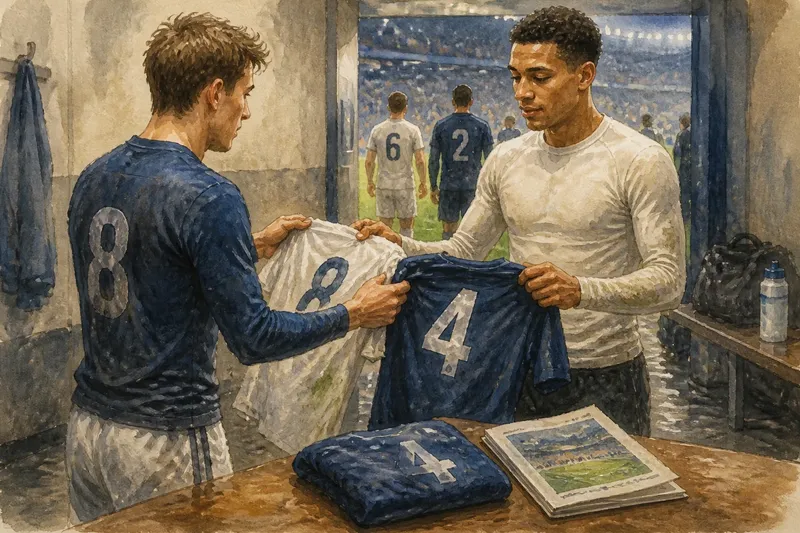
The common mistake is to treat a post-match jersey exchange as a souvenir swap between friends. That can make a deliberate choice look like routine trading. Why teams exchange jerseys after a match has more to do with recognising a particular contest than with acquiring another piece of kit.
A shirt can preserve details a scoreline leaves out
A match report records the result and its main events. A shirt carries less orderly evidence: a grass stain, a stretched cuff, a number attached to a close marking duel. These traces do not explain the match, but they can prompt a player to remember its texture rather than only its outcome.
The object’s meaning is personal, not automatic. A clean spare shirt might matter because it came from a memorable opponent; a match-worn one might mean little to its recipient. What matters is the specific association the two players attach to the exchange.
The exchange marks a relationship that existed only in play
For much of a match, opponents are assigned narrow roles: track that runner, block that route, win that challenge. An exchange briefly sets those roles aside. It can acknowledge how the other player performed without recasting a competitive relationship as friendship.
That distinction is useful. A player can respect an opponent’s defending and still be irritated by the result. The shirt is not an apology, a peace treaty or evidence that rivalry has ended. It marks a moment of recognition between people who have just tested one another under the rules of the game.
The memory may belong to a small incident, not the headline
A celebrated final is an obvious source of keepsakes, but a shirt can also recall an unremarkable fixture and one sharply remembered exchange within it. Perhaps a winger kept beating the same full-back, or an opponent returned the ball after a stoppage. Such details are often absent from the official record because they were not decisive.
Say a visiting midfielder has spent a match tracking a younger home player, and both choose to exchange shirts afterwards. The younger player folds the jersey beside the programme. The starting point is a demanding one-on-one contest; the action is keeping the two objects together; the likely result is that the programme recalls the occasion while the shirt brings back the opponent and their duel. That memory does not depend on the home side winning.
The shirt offered may not be the one worn
Players sometimes exchange match-worn shirts, but a spare can be offered instead. A player may have promised the worn shirt, need to return it to club staff or simply prefer to keep it. The recipient should not assume that a spare makes the gesture insincere.
Nor is a request an entitlement. Kit arrangements vary between clubs and competitions, and a player may decline without intending an insult. The practical choice says little on its own about how either person judged the match.
Keeping the shirt raises ordinary care questions
Some recipients put an exchanged shirt away with tickets or programmes; others display it. If it is signed, check the care label and avoid washing it until you know how the ink and fabric should be treated. For framing, ask a reputable framer about suitable materials and placement away from direct sunlight.
Provenance matters if the shirt is later passed on or sold. Keep any note, message or documentation that explains where it came from, and do not add claims you cannot support. The history of an object is clearer when its story is recorded plainly rather than embellished.
Questions about post-match jersey exchanges?
Why do footballers exchange shirts?
Often, they want to recognise an opponent or retain a reminder of a particular match. The reason can be personal and need not be connected to the final score.
Do players exchange jerseys in every sport?
No. The custom is more familiar in some sports than others, and depends on the kit, competition and people involved. A lack of exchange does not establish a lack of respect.
Is a match-worn shirt always exchanged?
No. A player may offer a spare, keep the shirt or decline a request for practical or personal reasons. There is no obligation to hand over clothing.
How should a signed shirt be cared for?
Check its care label and ask a specialist framer for advice before washing or displaying a signed garment. Fabric and ink can respond differently to cleaning and light, so avoid treating every shirt as ordinary laundry.
Why teams exchange jerseys after a match becomes clearer when the shirt is treated as evidence of a particular encounter, not proof of a general friendship. If you receive one, record who gave it to you and which match it came from; that small note may preserve more useful context than a display label written years later.