Why a Basketball Possession Changes Shape After an Offensive Rebound
A basketball possession after an offensive rebound can reset the shot clock and change the play. Learn how timing shapes the next decision.
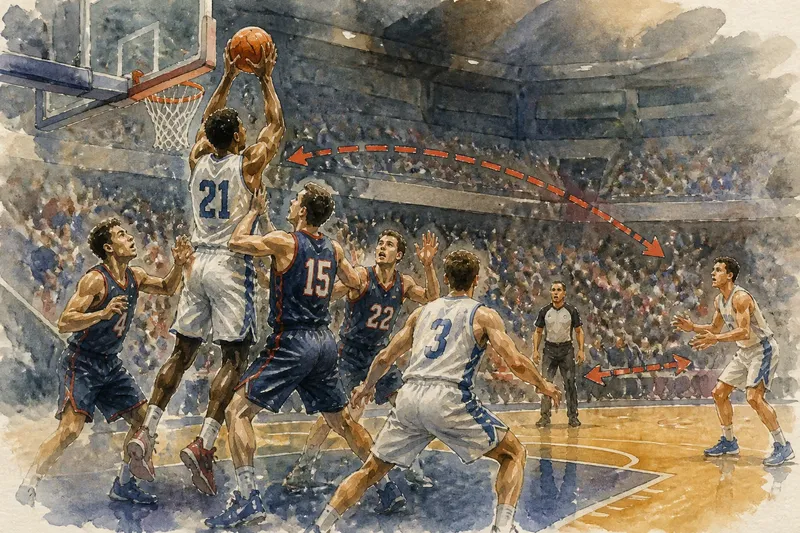
The common mistake after an offensive rebound is to treat it as a second chance to run the same attack. A basketball possession after an offensive rebound has changed: the shot clock may reset, defenders have shifted, and the rebounder may be far from a useful shooting position. The team has the ball again, but not necessarily the same play.
An offensive rebound keeps the attack alive
A possession is the period in which one team controls the ball and tries to score, ending when the other team takes control or play stops under rules that award it the ball. A defensive rebound usually ends that period. An offensive rebound does not. The attacking side recovers its own missed shot and retains control.
That distinction is easy to see on the scoreboard and less obvious on the court. The defence may have turned to box out, leaving players scattered around the paint. The attacker who secured the ball may be under the basket, while the original shooter is outside the arc. The team has regained possession, but its shape has been disturbed.
“Shape” here means the locations and readiness of the players: who can shoot, who can pass, which lanes are occupied, and whether the defence is set. The rebound keeps the same broad attack alive while creating a new, smaller situation inside it.
The shot clock changes the value of time
Basketball rules commonly allow the shot clock to reset after an offensive rebound, though the exact reset depends on the competition and where the ball is recovered. In many rulesets, a rebound in the frontcourt gives the offence a shorter reset than a new possession would. The practical point is that a reset does not always mean a full fresh clock.
That extra time can be valuable. A team may have been close to the shot-clock limit when its first attempt missed. Recovering the ball can give it time to organise another attack rather than forcing an immediate, poor-quality shot. But time is only useful if players spend it deliberately. A reset is not an invitation to stand still while the defence finds its marks.
The clock also shapes what is realistic. With only a brief window remaining, a quick put-back or a direct pass to a ready shooter may make more sense than calling a complex action. With more time, players can clear space, set a screen or move the ball to a better angle. The scoreboard clock and shot clock are separate; the latter governs how long the offence can continue before it must attempt a shot under the applicable rules.
The rebound creates a short transition inside the possession
An offensive rebound often begins in traffic. The rebounder may be off balance, facing the baseline or surrounded by defenders. Teammates may be moving towards the basket, not away from it. For a moment, the attack resembles a loose-ball scramble more than a planned set.
The first decision is often whether to finish immediately. If the rebounder has a clear path and a stable position, a close shot can exploit defenders who are still recovering. If bodies are crowded around the rim, forcing the ball up may turn a valuable recovery into another miss. A quick pass out can let the offence regain spacing and make the defence cover more ground.
This is why players often look to “kick the ball out” after a rebound. The phrase describes passing from the crowded paint to a teammate outside it. That pass can create a catch-and-shoot chance, but it can also prompt the defence to rotate and leave a new gap. The right outcome depends on who is open and how much time remains, not on the label attached to the pass.
Available options depend on who recovered the ball
The rebounder’s location and balance matter as much as the clock. A guard who collects the ball near the perimeter may be able to see the whole floor and direct the next action. A centre who gathers it beneath the hoop may have a close scoring chance, but less room to survey the defence. Teammates should respond to the actual recovery rather than run automatically to their usual spots.
Common options include:
- Put-back: The rebounder attempts a close shot before defenders recover. It suits a clear, controlled chance, not merely a crowded one.
- Pass out: The ball goes to a player outside the paint, restoring width and opening a possible outside shot.
- Reset the attack: A pass to a ball-handler allows the team to call or run another action, if the clock permits.
- Relocate: Players move to create a driving lane or clear the area around the ball, rather than all converging on the rebounder.
Imagine a team whose first shot misses and whose forward catches the ball near the baseline. The shot clock has reset, but two defenders are between the forward and the rim, while a guard is free beyond the arc. If the forward passes out, the guard can shoot or move the ball again; if the forward forces a contested attempt, the defence has little reason to leave its position. The observable difference is not simply another shot, but whether the offence makes the defence adjust.
Why does the next play look different?
Does an offensive rebound start a new possession?
Usually, it continues the same team’s possession because the opponents have not gained control. The shot clock may reset, but that timing change does not itself make the attack a new possession.
Does the shot clock always reset fully?
No. The reset can depend on the competition’s rules and whether the rebound occurs in the frontcourt or backcourt. Players and coaches work from the clock and signals used in their competition.
Why pass out instead of shooting again?
A pass can move the ball away from congestion and give the offence a clearer angle. A put-back remains sensible when the rebounder has a controlled, open chance; the choice is about the defence and the remaining time.
Can the defence still regain the ball?
Yes. A pass, dribble or second shot can be intercepted, stolen or rebounded by the defence. Until the offence scores or loses control, the initial offensive rebound has only extended its opportunity.
The reset rewards recognition, not hesitation
After an offensive rebound, players need to notice two things at once: how much time the clock allows and what the rebound has done to spacing. A team that sees only the reset may waste the moment. A team that sees only the scramble may rush a shot it does not have to take.
That is the useful way to read a basketball possession after an offensive rebound. It remains one possession, but its immediate problem has changed from creating the first shot to making use of a recovery. Watch where the rebounder lands, how quickly the defence turns back, and whether the ball moves out of traffic. Those details explain why the next few seconds can look like a new attack without actually being one.