The Cricket Ball’s Seam: A Raised Line with Several Jobs
Learn how a cricket ball’s seam is built and why its position matters to bowlers, umpires and anyone trying to read the ball’s movement.
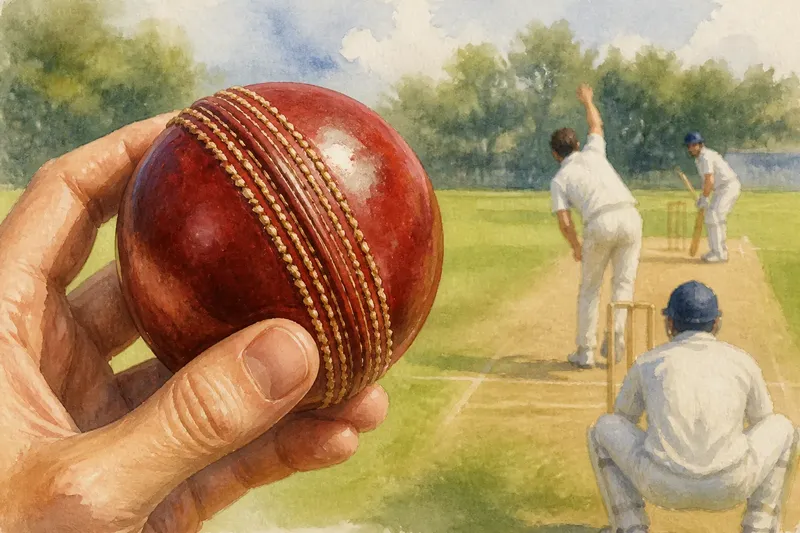
The most common mistake when looking at a cricket ball’s seam is to treat it as decoration. That misses a working feature: the cricket ball seam is a raised, stitched join that helps hold the leather cover together and gives bowlers a visible line to orient. Its position can matter to the ball’s flight, but it does not act alone or promise a particular result.
Start with a ball and a visible join
Imagine a clearly hypothetical club match before play. A new red ball is being examined at the boundary, and a curious spectator asks why one raised line runs around it. The ball has a cork-and-string core wrapped in layers, with a leather cover secured along a stitched join. That join forms the seam. The exact materials and construction can vary by ball type and maker, but the raised stitching is the feature the spectator can see and feel.
Rather than a single straight stripe, the seam follows a curved path around the ball. Its stitching is often prominent enough to catch a fingertip. On a new ball, the seam tends to look crisp; as the cover wears, scuffs and softens, its edges may become less distinct. The seam remains part of the ball’s construction even when it is no longer equally sharp all the way around.
The seam is not a separate strip attached for grip, nor is it a mark painted onto the leather. Stitching draws the cover together at the join, while the raised ridge creates a small change in the ball’s surface. That distinction matters: the seam’s visible line comes from how the ball is assembled, not from a graphic intended to identify a brand or model.
See how the seam is shaped
Cricket balls are commonly made with a leather outer cover and a layered core. The cover is formed from pieces joined around that core, and the seam stitches secure the join. Depending on the ball, makers may use multiple rows or patterns of stitching, producing a ridge with a distinctive height and texture.
At the seam’s crossing point, the stitching can look especially dense. This is often called the seam’s knot or crown. It gives the line a recognisable high point, although the precise appearance differs among balls. A spectator can compare the ridge around the circumference without needing to know the manufacturer’s construction details.
Other lines on a ball can cause confusion. A coloured logo, printed lettering or painted stripe may run across the leather, but these are not the raised stitched join. The seam can be identified by touch and by the small shadow it casts under side lighting. It is a physical change in the surface, not merely a line that happens to be visible.
In the hypothetical match, the spectator turns the ball in their hands and notices that the seam does not sit at the same angle from every viewpoint. Nothing has changed about the ball. The observer has rotated it, bringing different parts of its curved seam into view. That simple point will matter when the same ball is watched in flight.
Understand why seam position attracts attention
A bowler may present the seam in a chosen orientation as the ball leaves the hand. The raised ridge can affect how air moves around the ball, particularly when the surface and seam are in suitable condition and the ball is travelling in a suitable way. The outcome depends on several interacting factors, including the ball’s wear, its speed, the surrounding air and the angle at which the seam is presented.
That is why observers often talk about seam position. They are describing the direction the raised ridge appears to point relative to the ball’s path. It is not a switch that controls movement. A visible seam orientation may be one clue in understanding what happened, but it cannot explain every change of direction by itself.
There are two related ideas that are easy to mix up. “Seam bowling” commonly describes a delivery whose movement is associated with the seam’s interaction with the air or the playing surface. “Swing” generally describes movement through the air associated with differences in airflow around the ball. In ordinary commentary, the terms may be used loosely, and real deliveries can involve overlapping effects.
When a ball lands, the seam can also affect how it meets the pitch. A raised ridge that contacts the surface may make the bounce less predictable than a smooth patch of leather would. But the pitch, the ball’s condition and the precise contact all matter. The seam is one contributor to an event, not a complete explanation of it.
Follow the hypothetical ball from hand to pitch
In the invented match, the bowler delivers the new ball with its seam appearing upright from the spectator’s angle. It travels towards the batter and then moves slightly in the air. The spectator might be tempted to credit the seam alone. A more careful reading is that the seam’s orientation could have contributed, while the ball’s speed, surface condition and airflow also shaped what was seen.
The ball then strikes the pitch. It deviates after bouncing, and the seam is visible near the point of contact. Again, the observer has a clue, not proof. The seam may have met the surface in a way that influenced the bounce, but a slight variation in the pitch or the ball’s approach could also matter. From the boundary, the exact contact can be difficult to judge.
Suppose the next delivery has a seam that appears less upright, and it travels on a straighter line. That difference does not establish that seam angle caused the contrast. The bowler may have released the ball differently, the ball may have rotated, or the conditions may have changed. The useful lesson is modest: seam position gives viewers a feature to watch, while the ball’s full behaviour supplies the context.
By the end of the over, the ball’s leather has picked up marks. Its seam remains raised, but the surrounding surface is no longer pristine. The hypothetical observer can now see why the same seam orientation might not produce the same movement throughout an innings. The ball is a changing object, and its surface is part of the story.
Notice what changes as the ball wears
A new ball usually presents a firmer cover and a more distinct seam. With use, the leather can become scuffed, polished or softened, while the seam may flatten or fray. How it wears depends on the match, the conditions and how the ball is handled. Wear is not uniform, so one side may look different from another.
Those changes matter because airflow responds to the ball’s surface, and seam contact with the pitch depends on the ridge’s shape. A roughened patch, a polished area and a worn seam do not behave as identical surfaces. The effect is not simple enough to infer from appearance alone, but wear helps explain why bowlers and umpires pay attention to the ball’s condition.
Rules govern how players may maintain a match ball. The details depend on the competition and the applicable playing conditions, so a viewer should rely on those rules rather than assume that every action seen at one level applies everywhere. The important distinction for understanding the object is between ordinary wear during play and unauthorised alteration.
For the spectator in the hypothetical match, the practical observation is straightforward: compare the seam and leather together. A pronounced ridge on a well-kept ball is not the same visual object as a softened ridge on a heavily marked one. Noting that difference adds context without pretending to diagnose the exact cause of a delivery.
Why does the seam matter beyond appearance?
Does the seam make every delivery move?
No. It can influence a ball’s interaction with air or the pitch, but movement depends on several conditions acting together. A visible seam is not evidence that it caused every deviation.
Is the seam the same as swing?
Not quite. Seam refers to the raised stitched join and, in bowling discussion, movement associated with its orientation or contact. Swing usually refers to movement through the air linked to airflow around the ball, though the terms can overlap in casual commentary.
Why do viewers look at the seam in slow motion?
Slow-motion footage can make the ball’s rotation and orientation easier to notice. It still cannot show every relevant condition, such as the precise state of the surface or the airflow around the ball.
Does the seam look identical on every cricket ball?
No. Construction, stitching pattern, ball type and wear affect its height and appearance. The maker’s description and the rules for the competition are the right sources for product-specific or match-specific details.
Read the ball without overreading it
After the hypothetical over, the spectator can explain what the seam is: the raised stitched join that secures the ball’s leather cover. They can also explain why bowlers care about its orientation and why viewers watch it near release and at bounce. What they cannot do from the seam alone is name the precise cause of every movement.
The cricket ball seam is most useful as part of a larger visual reading. Look at its angle, the ball’s rotation, the state of the leather and the point where it meets the pitch. Then leave room for conditions that a spectator cannot see. That makes the raised line more than decoration, without turning it into a small, red answer to every question about the ball.