A First Visit to a Sumo Tournament: Follow the Bout's Ritual Sequence
A first visit to a sumo tournament is easier to follow when you know what each bout ritual signals, from the ring entrance to the first charge.
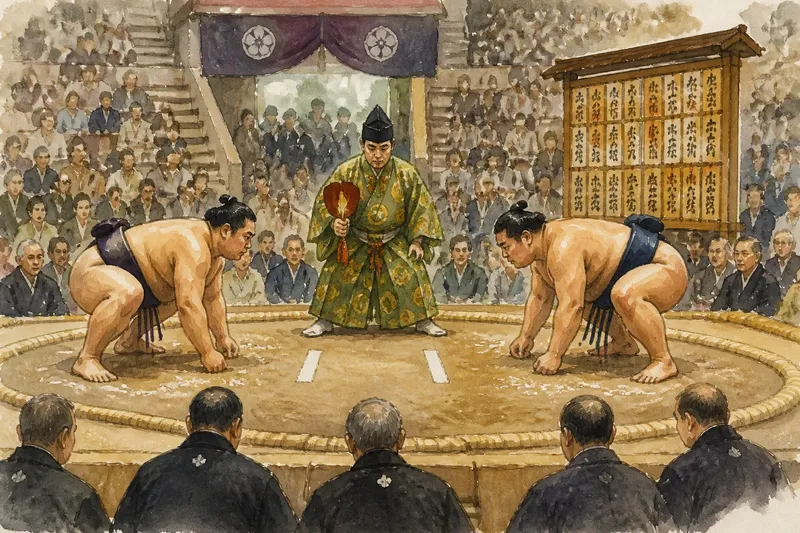
The common mistake at a first sumo tournament is to treat the preparation before each bout as dead time. The cost is losing the thread of the event: who is approaching, what the referee is doing, and which movement actually starts the contest. A first visit to a sumo tournament is easier to follow if you watch the ring as a place being organised, not merely a stage waiting for a collision.
That distinction matters because sumo makes its structure visible. Wrestlers enter, take their places, repeat familiar gestures and then charge. The pauses are part of the audience’s chance to read the encounter: two opponents preparing at their own pace, with the referee directing the start. You need not memorise every custom. A few landmarks will do.
Know the bout’s basic shape before you arrive
Sumo tournaments are commonly called basho. Bouts are arranged by division, with lower divisions generally appearing earlier and the top division later. A visit can include long intervals between bouts as well as contests that end quickly. Check the venue’s current programme and entry information before setting off. The programme helps you choose when to arrive; it does not promise uninterrupted action.
Three points make the ring easier to read. Wrestlers begin on opposite sides. A bout ends when one leaves the ring or touches the ground with a body part other than the soles of the feet. A referee, the gyōji, directs the contest inside the ring, while judges sit around it.
Each wrestler has a ring-entering name, or shikona. The announcer’s call and the tournament board connect that name to the next pairing. If you cannot read Japanese, a printed programme or venue display may provide names in another script. Follow the listed pairing rather than trying to identify wrestlers by their topknots or belts.
Choose your arrival and seat around the programme
Earlier bouts offer a chance to learn the arena’s rhythm before it fills for the top division. If you are arriving later, leave time to pass through the entrance, find your seat and check the programme. A clear view of the ring helps with footwork more than a seat chosen only for proximity.
At the venue, check the signs for your entrance and seating area. A cushion may be supplied or available, depending on the arrangement. Floor seating requires a different posture from a chair, so choose what suits your comfort. Keep bags within the space permitted by the venue, and do not lean into the ring area for a photograph.
Say you arrive during a top-division bout and cannot tell which wrestlers are competing. Check the board for the next pairing, then settle in before those wrestlers enter. The result is simple: you can match the names to the people from the start of the next sequence instead of trying to reconstruct it from the crowd’s reaction.
Read the ring ceremonies as event structure
Before top-division bouts, wrestlers take part in the dohyō-iri, or ring-entering ceremony. They appear in groups wearing decorative aprons. It is not a team contest. The ceremony introduces the division as a group before the programme returns to individual pairings.
When the ceremony ends, the wrestlers leave and bouts approach one by one. Watch the announcer and the direction from which each wrestler enters. That is a practical way to match a name to a person without having to recognise rank symbols or know a wrestler’s record.
The gyōji is identifiable by the fan and formal attire. The referee’s position and gestures help organise the bout. Judges around the ring are part of its officiating structure, not spectators with unusually good seats. Their role becomes more visible if a close decision needs review.
Watch how preparation becomes a start
Before the charge, wrestlers may stamp their feet, clap, raise their arms, throw salt onto the ring and crouch opposite one another. The order and duration vary. These gestures are not a fixed countdown. Wrestlers can repeat parts of the preparation before both are ready to begin.
The foot stamp is called shiko. Salt is thrown as a purification gesture. Both are part of sumo’s ritual vocabulary, but the most useful cue for following the action is simpler: keep both wrestlers in view. One may crouch while the other rises, or both may return to their corners before trying again.
The sequence is less a clock than a negotiation of readiness. The crowd may be attentive, but its expectation does not itself start the bout. Watch for the moment when both wrestlers settle low and launch forward together. That first charge, the tachiai, is the contest’s opening collision.
Imagine you see one wrestler crouch, then rise while the other remains in place. Treat the action as preparation, not a false start; continue watching both sides of the ring. When they eventually charge, you have a clear point from which to follow the exchange, rather than relying on noise from the stands to tell you when it began.
Follow the contest, decision and reset
After the tachiai, wrestlers use pushing, gripping and balance to force an opponent out or down. Keep track of who is being displaced and where the ring’s edge lies. You do not need to follow every hand movement to understand the broad shape of the contest.
The gyōji signals the winner, often by indicating that wrestler with the fan. Judges may review a close decision. That pause belongs to the officiating process; it is not the start of another round.
After the decision, the wrestlers leave the ring and the next pair is called. Use the reset to check the next pairing, adjust your view or take a break if the venue permits. The names and movements change, but the main landmarks remain easy to recognise.
What do spectators ask about the ritual?
Why do wrestlers throw salt?
Salt is a purification gesture associated with the ring. It is not a technique intended to affect the opponent. Treat it as one sign that preparation is under way.
Why do wrestlers crouch more than once?
The wrestlers may repeat their preparations before the charge. A return to position means the bout has not yet begun, even if the audience is waiting for it.
What is the referee holding?
The gyōji holds a fan called a gunbai. Its movement helps direct the bout and signal the official result.
How can you tell when the bout starts?
Watch for both wrestlers to launch forward from their crouches. The opening collision is the tachiai; the earlier gestures belong to preparation.
Keep the day in view between bouts
A tournament is a programme, not just a run of headline contests. The lower divisions, ceremonies and pauses show how the event is organised. Use the programme to choose a sensible arrival time, and take breaks rather than expecting every moment to contain action.
For a first visit to a sumo tournament, the most useful habit is to notice changes in position, not to memorise a long list of ritual details. Ring entry tells you who is approaching; the crouch signals readiness; the charge begins the contest. The pause is doing a small job: giving you time to see who is about to move, which is not a bad arrangement for a sport that can change direction quickly.